Nuclear First
Why gas must be secondary in UK power strategy
Read summary
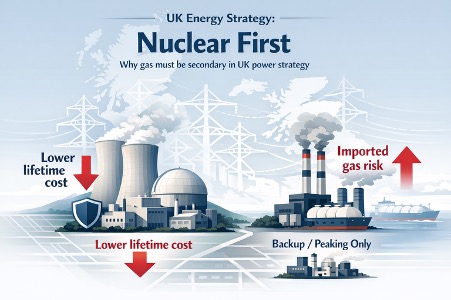
This policy brief argues that a nuclear-first strategy offers the UK a stronger long-term energy model than a gas-first approach on financial and strategic grounds alone. Over an 80-year horizon, the paper estimates that gas-based expansion would cost roughly £830bn–£1,200bn, compared with about £430bn–£580bn for nuclear, with much of the gas expenditure flowing abroad through imported fuel. The brief contends that nuclear therefore provides lower lifetime costs, greater domestic economic retention, and a more secure platform for long-term industrial growth.
The document also argues that a large-scale gas strategy would quickly exhaust domestic reserves and lock the UK into long periods of import dependence, while nuclear benefits from a more diversified fuel supply chain and longer operating lives. It recommends designating nuclear as the country’s primary baseload power source, limiting gas to balancing and strategic industrial uses, accelerating Rolls-Royce SMR deployment, pursuing multi-unit conventional nuclear sites, simplifying regulation, and using long-term nuclear power agreements to attract major industrial and data-centre investment.